Bioshock for Mac

October 7 marks a key point in next-gen Mac gaming, as it marks the date that Unreal Engine 3.0 finally sees a release on the Mac. Feral Interactive have announced they will be releasing a native port of 'Bioshock'. I'm rather confused about the state of Unreal Engine 3 for Mac. I know well the port was well underway in 2005 when I contacted the developer, and at the time it was planned for PowerPC G4 and upwards. The desire was to make it Intel-only, but back then it wasn't quite feasible. Asides the obvious issues, also, at the time, bugs in gcc4's code generation were a big problem. Eventually Unreal Tournament 3 was announced for Mac in December 2007 by Macsoft, and Gears of War was also officially stated to 'be coming'. Neither game have seen the light of day as of yet, although Ryan Gordon posted screenshots of the Mac version a year ago. Unfortunately, this is what the native Mac gaming situation is right now; broken promises and many-years-late ports. I'd like to say that at this point the engine wouldn't be relevant or the most amazing graphics engine on the block, but I'd be lying. Even now, three years after Gears of War was released on Xbox, no developer has ported a game with graphics of that calibre to the Mac. Even so, I'm very excited to see Bioshock come to the Mac, and can't wait to play it. Here's Feral's press release:

DATE:

Thursday, September 24, 2009

On October 7th, prepare to descend to the depths of the undersea city of Rapture when Feral Interactive releases the critically acclaimed BioShock® for Mac. Developed by 2K Boston and 2K Australia, and originally published by 2K Games, BioShock introduces gamers to an exciting world filled with fascinating characters, intelligent enemies and complex moral choices that define the foundation of the game’s world. With its rich story, meticulous attention to visual detail, tense action and infinite replay value, BioShock delivers the perfect blend of storytelling and first-person action.

Barely surviving a plane crash, the player lands in icy uncharted waters and discovers the undersea city of Rapture, a failed utopia whose citizens had embraced genetic engineering before descending into pure anarchy. Power and greed have run amok and the city has succumbed to civil war. To survive, gamers must turn everything they find into a weapon, use their powers of observation to piece together what happened and make the difficult decisions necessary in order to escape a paradise gone badly wrong.

Fans have embraced BioShock’s mysterious world filled with powerful technology and creative gameplay. BioShock is also renowned for its rich visual detail depicting a gorgeous Art Deco world set deep beneath the sea.

“The look and feel of BioShock is breathtaking,” said Feral Interactive’s David Stephen.“Combined with the remarkable depth and sophistication of the storyline, as well as the pure adrenaline rush of playing, BioShock will set new benchmarks for Mac gaming.”

BioShock will retail in North America for US $49.95,£34.99 (inc. VAT) in the UK and€39.95 (inc. VAT) throughout Europe. It is currently available to pre-order from Feral's online store ( http://www.feralinteractive.com/?section=buy&language=english).

More details are now available at: http://feralinteractive.com/game/bioshock.

Minimum system requirements for BioShock include a 1.8 GHz Intel Mac, 1.5 GB RAM, 128 MB graphics card, DVD drive, 8 GB of hard disk space and Mac OS X v10.5.8 or later. The game does not support Intel GMA integrated video chipsets, but does run on the latest generation of MacBooks and Mac Minis.

EDITORS: Screenshots, logos and other essential graphics and multimedia tools for BioShock can be found online in the Feral Press Area ( http://press.feral.co.uk). Please use your assigned login recently provided to you. If you do not have a login, please contact Brad Gibson, Feral Marketing/PR Manager, at bgibson@feralinteractive.com.

About Feral Interactive

Feral interactive is a leading publisher of games for Macintosh platform founded in 1996 and based in London, England. It is responsible for such Macintosh hits as Black&White, Colin McRae Rally Mac, Lego Star Wars II and Tomb Raider Anniversary.

All trademarks and copyrights contained herein are the property of their respective holders.

CONTACT:

Brad Gibson at bgibson@feralinteractive.com

+1 918 691 3420

Palm Pre Launches in Ireland October 16

The launch date and pricing has finally been announced for O2's exclusive on the Palm Pre. It's pretty clear that the pricing was chosen to compete with iPhone, with the device starting at €99 on the lowest plan, and free on the highest plan. Virtually all the plans are the same as the iPhone plans featurewise. You're looking at €419 if you're wanting to pick one up off-contract, although you're still SIM-locked to O2 (although, to be fair, since the device is so open and hackable I wouldn't expect that to last long). It's also pretty damning that Android was announced in November '07 and there's still not an Android phone available officially in Ireland. It just looks like the carriers here don't want anything to do with it :-)

RSS State of the Union, 2009

A day ago I posted a quick survey to Twitter about the state of RSS on iPhone. Over a hundred people responded with pretty much the same answers:

There is currently no 'good' RSS application on iPhone. There's a clear demand for a really sweet looking, fast, and easy to use news reader that syncs with Google Reader. Those who said they don't use an RSS reader on iPhone said it was for want of an acceptable, native client.

Most people have settled on Byline as their news reader, and there are a lot that just use Google Reader through Safari.

Quite a few people mentioned that they want a news reader that is more like a good Twitter client (although, you could say the response base was biased).

Roughly $5 seems to be the general consensus regarding what a good RSS reader should cost, with some people saying they would never pay for an RSS reader and even some saying they'd pay over $10. Certainly interesting information for anyone pricing their applications.

Only one person mentioned they'd like feed searching, but the majority did specify that they want caching for offline viewing.

A built-in browser and attachment viewing is also ranking heavily among wanted features.

Interestingly, several people said that they would absolutely hate if the app adds an 'unread' badge on SpringBoard. I understand that myself, as I hate the unread badges, but it's nice to see I'm not alone.

Those whom mentioned a landscape feature said they'd want the ability to disable any landscape modes entirely, so that they can easily read when not standing/sitting up. Not one person said they'd like a landscape mode for reading.

Finally, Instapaper, Twitter and Facebook integration were mentioned several times, as well as in-app e-mailing of articles.

Useful results, and it shows a clear market for a fresh news reader. I can certainly add that to my 'ToDo' list of possible iPhone projects :-) Hopefully this data is useful to other developers and iPhone users.

The Cider Portability Engine

I want to spend a blog post gushing on a technology, in particular, Cider from TransGaming Inc. In the past, games companies porting titles to the Mac had to either rewrite a game to run, or they had to rewrite a game to work with their own DirectX compatibility layers. This process takes a lot of time and money, as you can imagine. Cider changes the game completely. Cider is a wrapping technology that runs the Windows versions of a game in an 'emulated' form, essentially translating all the Windows and DirectX specific stuff to run directly on the Mac. The way it works is essentially simple and very easy for TransGaming to adapt to new titles; it literally encompasses the entire Windows folder structure including the game, and runs the actual Windows binary (.exe) as if it were a Mac application. This provides you with a double-clickable Mac game that, to the end user, seems just as native as any other Mac game. Naturally, there is a performance penalty (which differs depending on the game) but it's often not that much worse than an actual native port of a Mac game. Because a Cider game package is so simple, fans and hackers alike have taken it upon themselves to try and wrap other, existing Windows games in Cider wrappers. Naturally this bends all sorts of licensing issues at the least, and is piracy at the worst, but the potential is there to flag a list of popular games that will work with minimal effort using Cider so that TransGaming themselves may try and court the developers and see if they want a Mac port. Cider itself is ever-evolving, and today boasts much better performance and compatibility than a year ago. It leverages features of OS X like multithreaded OpenGL, and is a self-contained bundle (there's no user-facing directory tree for a game, just the game itself you can drag and drop anywhere you like). Naturally, as Cider itself improves, so do all the games it works with. For many games, making them run is a simple case of tweaking configuration files and replacing the internal Windows game folder with that of your choosing. Other games require more poking and often require no-cd versions of the Windows binary. Other games don't work at all. But those that do include such impressive titles as: • Assassin's Creed • Dawn of War (and expansions) • FarCry • Elder Scrolls: Oblivion • Half Life 2 • Grand Theft Auto 3 (and Vice City, and San Andreas) With the latest version of Cider (included in the Warhammer Online free demo), even Fallout 3 now launches to the main menu (although the actual game part doesn't yet work). I'm optimistic that a future version of Cider will run Fallout 3 perfectly. Naturally, in the official scene, EA, among others, is making massive use of Cider. Some official games that use it are: • The Sims 3 • Spore • Command & Conquer: Red Alert 3 • Warhammer Online • Battlefield 2142 I did some unscientific tests pitting the native OS X (Intel) version of Doom 3 up against a Ciderized Windows version of Doom 3 (that I hacked together for the purposes of this blog post) on a last-gen MacBook Pro. The Cider version performed about 50fps, on average (60fps being the standard maximum refresh cap on Doom 3). It looked identical to the Mac version, and performed just as well at the same resolution. Doom 3 (id tech 4) is one of the most graphically demanding engines that Aspyr (arguably the premier native Mac porting house) has ported to the Mac. That the Windows version of the game, using the Cider portability engine, is able to run just as smooth is certainly a sign. I believe that there's not much future for native Mac gaming, and Cider is the future. Cider games are performant, and can be released on the same day (in same box) as the Windows versions. Contrast that to the native Mac porting scene: • Black and White 2 was released in early 2009 for the Mac, four years after the Windows version • Call of Duty 4 was released a year after its Windows counterpart • Gears of War and Unreal Tournament 3 were promised for (and mostly ported to!) the Mac, still haven't been released • SimCity 4, ported by Aspyr to the Mac in 2003, even as a Universal Binary and Intel-native, _still_ does not run smooth on the latest Macs. Long live native Mac gaming. You won't be missed :-)

Google’s Response To The FCC

Techcrunch has Google's response. Interestingly, Google is the only member of the three to have redacted portions in their letter.
"The redacted information relates specifically to private business discussions between Apple and Google regarding the Google Voice application and, as such, it constitutes commercial data 'which would customarily be guarded from competitors'…"
Hmm…

AT&T's Response to the FCC

AT&T's response to the FCC has also been made public.
"…we plan to take a fresh look at possibly authorizing VoIP capabilities on the iPhone for use on AT&T's 3G network"
Possibly the most interesting tidbit from the sixteen-page document; if AT&T relents and begins to allow VoIP services such as Skype on their network, it bodes well for Apple allowing iPhone VoIP apps work over 3G worldwide.

"Apple Answers the FCC’s Questions"

Apple today published their answers to the FCC's questions regarding the Google Voice rejection issue and it contains some very interesting information about the App Store.
"There are more than 40 full-time trained reviewers…"
Merely forty full-time reviewers for 65,000 applications and counting. Crikey! As far as I know, most, if not all, of them are based in Cupertino, so AT&T's network terms-of-service is law when developing your app.
"…at least two different reviewers study each application so that the review process is applied uniformly"
This makes sense, but it clearly shows why reviews for the App Store take so long.
"…roughly 20% of [apps] are not approved as originally submitted"
Interesting statistic; Apple does mention that the majority of rejections are for bugs and QA issues, and developers are free to fix and re-submit. No figure is given for completely denied apps.
"In little more than a year, we have reviewed more than 200,000 applications and updates."
If I didn't think those forty people were overworked before, I certainly do now.

RE 'The Android Opportunity'

John Gruber over at Daring Fireball has posted a great article about Android, detailing what he thinks handset makers should do to prevent Android from becoming an also-ran. He also writes:
Emphasize that Android apps are background-capable, and that there is no centralized App Store under one company’s ironclad control. There are no tales of rejected Android apps because there are no rejected Android apps.
Seems like he's forgotten that Google actually do remove apps from their marketplace:
Google has reportedly pulled tethering apps from the Android Market. According to at least one developer, who contributed to the WiFi Tether for Root Users app, Google are citing their distribution agreements with carriers as the prompt for removal: “Google enters into distribution agreements with device manufacturers and Authorized Carriers to place the Market software client application for the Market on Devices. These distribution agreements may require the involuntary removal of Products in violation of the Device manufacturer’s or Authorized Carrier’s terms of service” — Google Developer Distribution Agreement
An unfortunate addition is that Google restricts developer phones from being able to download or buy paid apps from the Android Market.
Google is denying those developers access to copy-protected applications sold in the Android Market because developers have a higher level of access to the G1 phone than regular users, and could potentially break the copy protection on those applications…
Not a good way to treat your developers, I would think. If you submit a paid app, you cannot even see it on the store from your developer phone; you have to buy another Android device to test it or see what it looks like on the store.

EeePC 901 + Snow Leopard

I found this article earlier explaining the quickest way to install Snow Leopard (10A432) on a PC box, so I decided to install onto my EeePC netbook to test the theory. It works! Alright it isn't as simple as that. Here's the status right now with just my simple mods: As you can imagine, the trackpad issue is bothering me just a little… You'll have to do a bit of hacking to get to the state above, however. I cannot, and will not, provide copies of any of the hacks performed below; I have given a reasonable amount of information so that others can do that for you. Please don't ask as I won't respond. Keyboard Support You will need to compile yourself a Snow Leopard version of the VoodooPS2 drivers from http://chameleon.osx86.hu/. This is relatively straightforward, but means you need a working Snow Leopard machine with a working 10.6 SDK. You will need to switch compiler to GCC4.0 for one of the drivers to prevent a compile error, and you will also need to edit a line ('private' to 'public') in an OS header to convince something else to compile. Theoretically, this driver should enable the trackpad too but it hasn't for me, but someone with more experience may fix this (please do! and send me the working one!). Graphics Driver You will need an Eee-compatible copy of Natit.kext (I used the one from the EeeMac driver set) and you will also need to hex-edit the AppleIntelGMA950 and AppleIntelIntegratedFramebuffer kexts to accept your graphics card (find and replace all instances of 8680A227 with 8680AE27 in both). You will need to edit the Info.plist of both kexts too to add your card's ID (0xae278086). Bluetooth You will need to add your Bluetooth device/vendor IDs to IOBluetoothFamily.kext's BroadcomUSBBluetoothHCIController.kext. Audio You will need to install CHUD from the Developer Tools included on the Snow Leopard disc. You will also need Audeee. Follow instructions on the EeeMac blog for Leopard to see how it works. Other Follow the rest of the instructions on the EeeMac blog that don't involve replacing extensions. A lot of the hacked extensions that worked on Leopard will fail to load on Snow Leopard and may render your machine unbootable. If you want to experiment, at least know what you're doing.
After doing all that, you'll have a mostly-working Snow Leopard install on the Eee. :) I haven't done any performance testing, as it's a pain using an external mouse for the moment. Everything feels snappy, and I played a 720p trailer (of Bolt) from the Apple website and it was watchable. Happy hacking! I cannot, and will not, provide copies of any of the hacks performed above; I have given a reasonable amount of information so that others can do that for you. Please don't ask as I won't respond.

iNdustrial Design

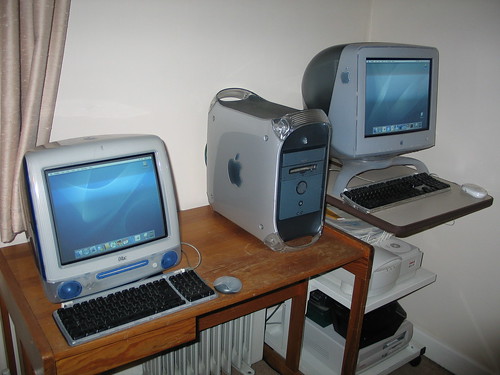
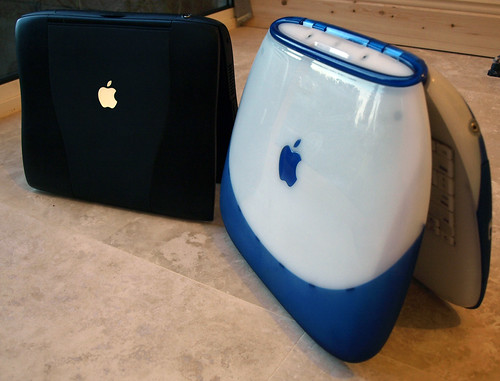
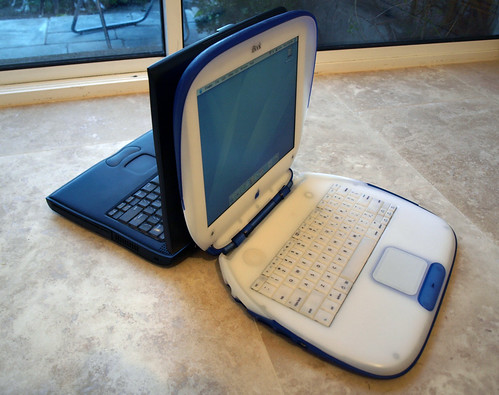
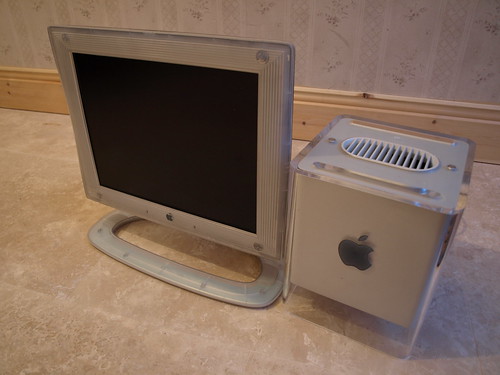
Lately I have been subjecting my Twitter followers to photographs of (…pause…) Apple hardware. Specifically, older Apple hardware designed by Jonathan Ive and his team. Apple has always had design foremost in their product planning, but it was Ive who infused Apple's industrial design with an energetic and youthful vibrance. Apple often mentions their major product innovations, with milestones set at the original Macintosh introduction, the iPod introduction, and the introduction of iPhone. You could argue that the original iMac was of the same calibre in its impact on the world of computing. It made such a splash because it bucked conventional thinking about the design of devices from the inside out. It was that inspiration that redefined Apple. Apple was pushed towards a new, youthful market, whereas before the original diehard Mac fanatics were trending towards the older age groups. It was this youth that pushed Apple towards OS X's UI, music, iPod and iPhone. You can see it in all of Ive's designs too, with their translucent plastics and beautiful curves. He was just past 30 when the iMac was released, but you could tell he was still a twenty-something at heart. Apple, including Ive, has grown up since. It's a very different company from that which inspired me to enjoy computers. While I really like the current design trend (Silver + Black), I still have a special place in my heart for the older designs. I've made it my duty to lovingly collect and preserve as many examples as I can, so as of late I've been scouring everywhere for people getting rid of older Macs and inspiring hardware designs. Word-of-mouth (and eBay) is great, although the biggest problem so far is shipping (computers tend to be heavy). You can keep an eye on my Flickr if you're interested to see what I pick up, as I tend to photograph everything. :-)

Retro-envy

With all this talk of an Apple tablet in the news recently I was overcome with nostalgia (or, as I call it, 'retro-envy', considering I wasn't even five when the original Newton came out). Digging out my Newton MP2100, I determined to pimp it out with storage and some networking ability. I had a key hurdle to overcome before I could manage this: I didn't have a serial cable with which to install packages onto my Newton. After a little scrounging, I found an ancient EigerCom 33kbps PCMCIA modem that had been used in an old PowerBook 1400cs. Assuming this would 'just work' with my phone lines, I hastily plugged it into the Newton and into the wall. Fortunately, the Newton recognized and could use this card off the bat (handy!). The only problem was actually dialing up! Nine out of ten times, the modem would complain that it couldn't find a dial tone. In the end, I switched the modem to the 14.4kbps mode which allowed me to dial in every time. Getting WiFi working isn't too difficult, if you do it right. If you do it wrong, like I did, you'll spend hours scratching your head wondering why it won't work. I followed the great howto on the 'My Apple Newton' blog and installed everything I needed. I also installed the 'More WiFi Cards' package, thinking it may be useful in the future. Big mistake! Apparently, if you install the 'More WiFi Cards' package, it stops the standard accepted WiFi cards from working. It took me several hours to realize this, after purchasing a cheap Lucent Orinoco Gold 802.11b card from eBay and trying to configure it with my network. The good news: it works without problems on the latest Airport Extreme base stations (if you have b/g compatibility turned on). Here's a quick shot of my MP2100 on Twitter: I have since ponied up for a working serial cable and used both unixnpi (command line) and NCX to install packages. NCX also allows you install packages over WiFi, which makes things a lot easier and faster. Considering the MP2100 was released in 1997, two years before 802.11b even existed on paper, I think that's quite a feat. :-) While browsing eBay for Newton-related items, I came across this MP120 in perfect condition for a mere £21. I placed a bid a couple days before it closed, fully expecting to be outbid by a large amount. Amazingly, I wasn't, and today my beautiful MP120 arrived. Definitely a steal! I have a few more retro goodies en route to me, ranging from ATA flash storage for the Newton (now possible thanks to the recently-released ATA driver) to an eMate 300, also a steal. Will post more about them when they come!

Palm Pre SDK != 'Web Apps'

Palm opened up their webOS SDK for the Palm Pre on July 16th, allowing anyone to check it out and start developing applications for the Pre. However, some developers are finding problems that prevent them from bringing their applications to the device. Craig Hunter, an iPhone developer, writes:
In my quest to re-experience the early days of app development on a new mobile platform, I didn't rewind one year like I was hoping -- I went back two years, back to the days when we could only develop web apps on the iPhone. I wrote this piece back then, bitching about the limitations of web apps on the iPhone. It seems we're right back in the same boat with webOS.
He specifically laments the lack of OpenGL|ES support and the accelerometer data being too inaccurate (currently limited to four readings per second). He raises some important points, with the above major stumbling blocks for those thinking of writing games, but he's wrong in saying that the Pre is akin to iPhone's web app 'SDK' as it was presented back at WWDC 2007. Palm's apps aren't web apps; yes they use javascript and HTML, but they tie into the system services with such. There is no other 'native' API; all applications, including the entire system shell, are built the same way and have the same capabilities. Really, Craig's found out that the Pre has (in effect) a sandbox for applications, and, if you think of it, it's not unlike the iPhone SDK sandbox. Bloggers lambasted the original iPhone SDK for providing only a baby subset of the actual features of the iPhone. Has it stopped growth, or a booming 65,000 app market with 1.5 billion unit sales? Of course not! Palm's lack of developer access to certain functions is a mere by-product of the immaturity of the platform. The reason there is no OpenGL|ES support on the Pre is because the Pre doesn't have an OpenGL|ES graphics driver. Currently the entire OS is using software-based drawing and animation (using directFB I believe). This is why webOS isn't as smooth as the iPhone in its animations or scrolling. But this is merely a software limitation, which will no doubt be improved upon with software updates. Palm has also proven that they're a much more open company than Apple in all their dealings with the Pre hacking community, which has impressed me to no end. I fully expect them to keep adding great features to their SDK and listening to the developer feedback. I do believe the accelerometer issue above to be an oversight; it's far more likely that Palm only envisioned game developers using the accelerometer at higher refresh rates, and the Pre wasn't initially designed for gaming, more being a re-imagining of Palm's canned Foleo project. That's not to say the Pre will never support gaming; the GPU in the Pre hardware is a damn good PowerVR SGX 530 chip, of the same family as that in the iPhone 3GS, just with a lower maximum polygon/sec count. As soon as there's a proper driver in the OS, and WebKit is re-tooled to use the GPU for its rendering, we should expect some really awesome updates to webOS. It's just a matter of time…

No promo codes for apps rated 17+

People are only now finding out what 17+ apps and rating systems entail; any application rated 17+ is refused the ability to have promotional codes generated, so you cannot send out review copies, etc. TUAW writes:
Apple specifies that any application that may contain high levels of offensive language, violence, sexual content, or references to drugs or alcohol receive a rating of 17+. But, according to Apple, apps that feature an embedded web browser or provide access to 3rd party content also automatically require the 17+ rating, regardless of the application's content or intended audience.
Marco Arment provides a little more detail:
Assuming Apple applies their standards on what constitutes “unfiltered internet content” somewhat uniformly, this will affect, among others, any subsequent versions of: Instapaper Every Twitter and Tumblr client that can show others’ content Every RSS reader Every Flickr client Every instant-messaging client (remember, text profanity counts) Every social-networking client Most ebook readers
However, it's worse than that. If you set a rating for an application before you've finished it and uploaded to iTunes Connect, there is no way to change the rating afterwards. So say, for example, you edit the application to remove offensive content or, as mentioned above, remove an inbuilt browser, you cannot change the rating for your application back to sane levels, thus preventing you from generating promo codes for it! Until recently it was even nastier: If you had even a single 17+ rated application entry on iTunes Connect, whether it had been uploaded/finished or not, you were forbidden from making any promo codes for any of your other apps, even if they were rated 4+. I fell into that trap by having my (unreleased) Doom port listed on iTunes Connect as 17+; for months I was unable to generate promo codes for my other apps until I contacted Apple with a 'WTF?'. Fortunately, you were able to modify the rating at the time, unlike now. I really hope Apple sort out this mess soon, because when the App Store system works it works really well.

SameGame v2.0

Coming Soon…